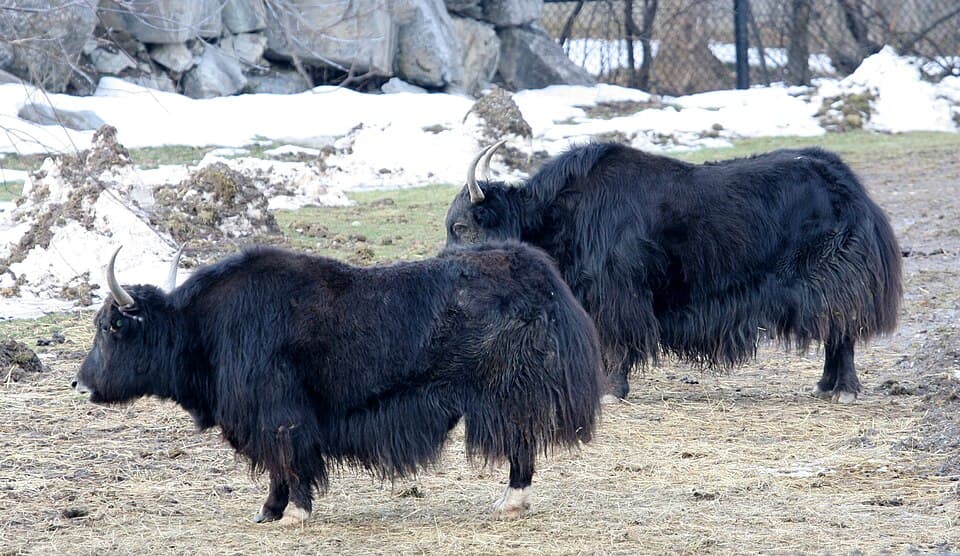
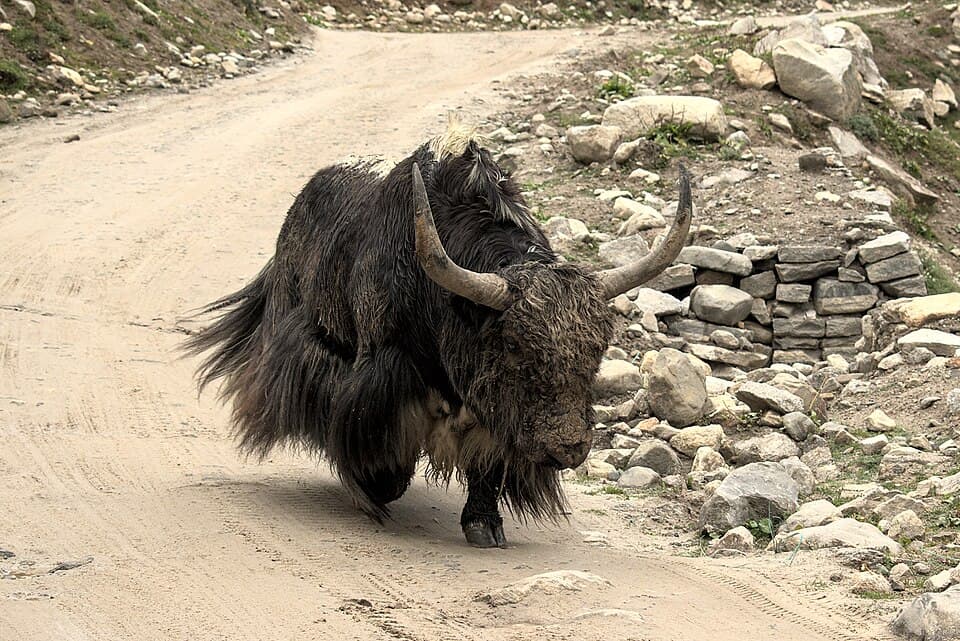
Photo: Dave Pape · Public domain · via Wikimedia Commons
Overview
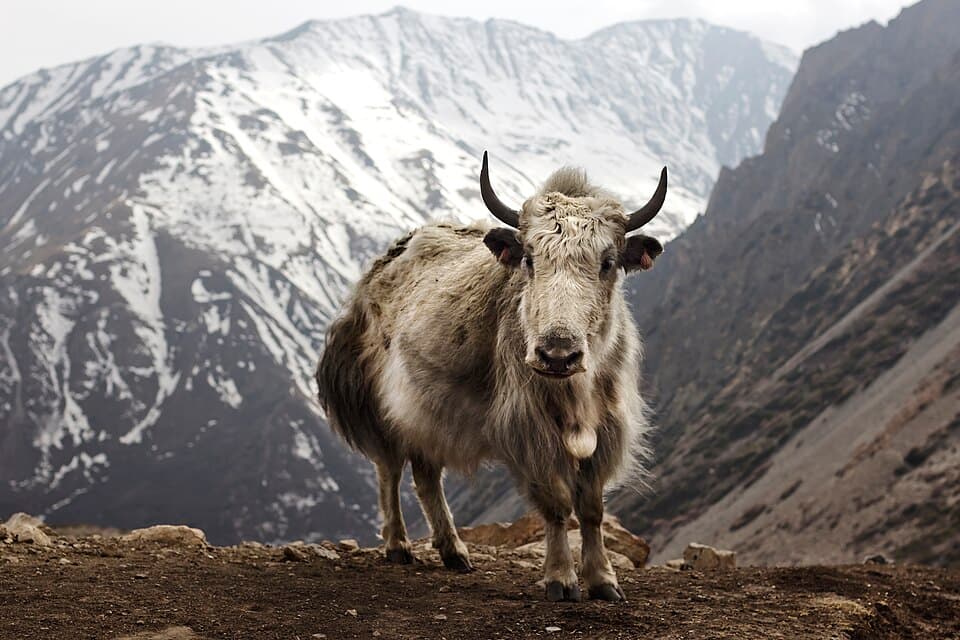
The yak is a large, long-haired bovine adapted to the extreme cold and thin air of the high Himalayan plateau, able to live at altitudes above 4,000 meters (13,000 feet) that few other large mammals can tolerate. Most yaks today are domesticated and have been kept for thousands of years across Tibet, Nepal, and the surrounding mountains as a source of milk, meat, wool, and transport, while small wild populations still survive on the remote Tibetan Plateau.
Appearance
It has a massive body covered in a long, shaggy dark coat, curved horns, and a dense woolly undercoat that traps body heat against extreme cold. A yak's coat hangs low enough to nearly reach the ground, acting as insulation and, in domesticated herds, a source of wool used for rope, tents, and clothing.
Habitat & Distribution
The yak is found in mountain habitats.
Diet & Behavior
Diet: Herbivore — Plant-eating animals that graze or browse on grasses, leaves, and other vegetation, from tiny insects to giant elephants.
Yaks are well-adapted to high-altitude life, with larger lungs and hearts relative to body size than lowland cattle, and blood that carries oxygen more efficiently in thin mountain air. They huddle together for warmth in herds and are highly sure-footed on steep, rocky terrain. Domesticated yaks are sometimes crossbred with lowland cattle to produce a hybrid known as a dzo, valued for combining a yak's hardiness with some of the size and productivity of domestic cattle.
Predators
- Snow leopard
- Wolf
Prey
This species does not prey on other animals.
Interesting Facts
- 1
Yaks have larger lungs and hearts relative to their body size than lowland cattle, an adaptation to thin mountain air.
- 2
Their thick coat lets them tolerate temperatures well below freezing.
- 3
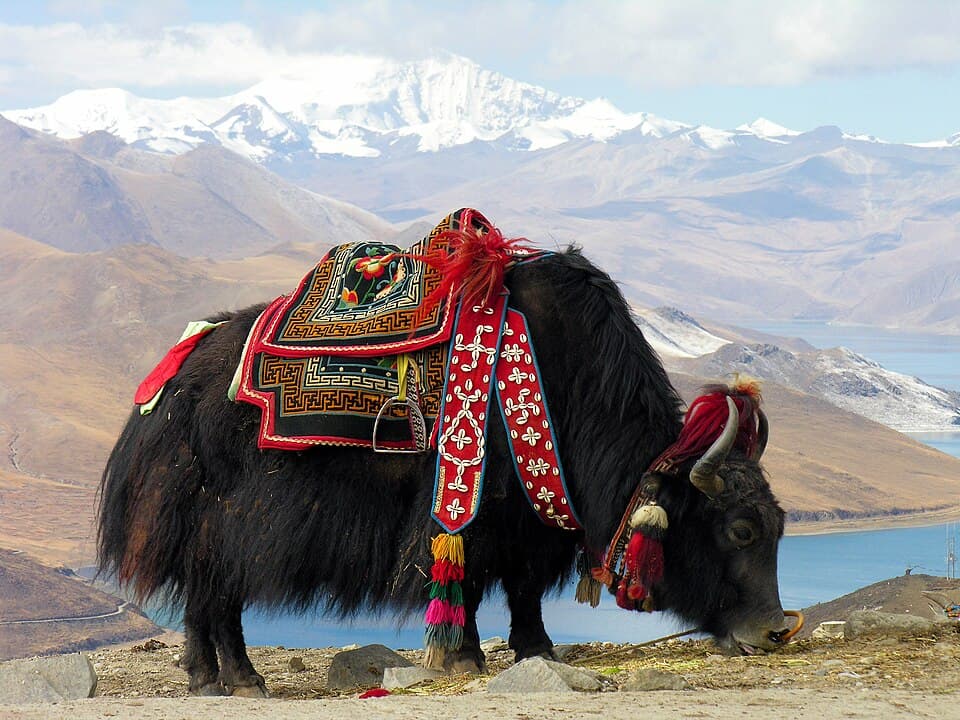
Domestic yaks have been used as pack animals in the Himalayas for thousands of years.
- 4
Yaks can live at altitudes above 4,000 meters (13,000 feet), among the highest-living large mammals on Earth.
- 5
Their milk is unusually rich in fat and is used to make Tibetan butter tea, a staple drink in the region.
- 6
In treeless high-altitude regions, dried yak dung is traditionally used as fuel.
Gallery
Yak FAQs
How high up do yaks live?
Yaks live at altitudes above 4,000 meters (13,000 feet) across the Himalayan and Tibetan plateau region, among the highest-living large mammals in the world.
What are yaks used for?
Domesticated yaks are used across the Himalayas as pack animals, and for their milk, meat, and wool. Their milk is especially prized for its high fat content.
Are yaks wild or domesticated?
Most yaks today are domesticated, but small wild populations still survive on the remote Tibetan Plateau. Domestic yaks are sometimes crossbred with lowland cattle to produce a hardy hybrid called a dzo.
How long do yaks live?
Yaks typically live around 20 to 25 years.
What does a yak eat?
The yak is a herbivore. Plant-eating animals that graze or browse on grasses, leaves, and other vegetation, from tiny insects to giant elephants.
Where does the yak live?
The yak is found in mountain habitats across asia.
Is the yak endangered?
The yak has a conservation status of Vulnerable. Species facing a high risk of extinction in the wild due to habitat loss, hunting, or other pressures.
How long do yaks live?
A yak's typical lifespan is 20–25 years in the wild.
How much does a yak weigh?
An adult yak typically weighs 300–1,200 kg.