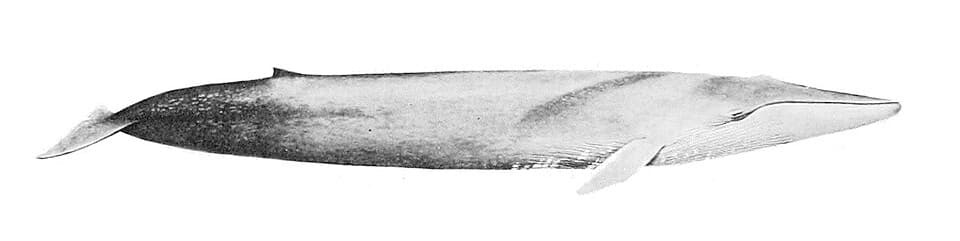
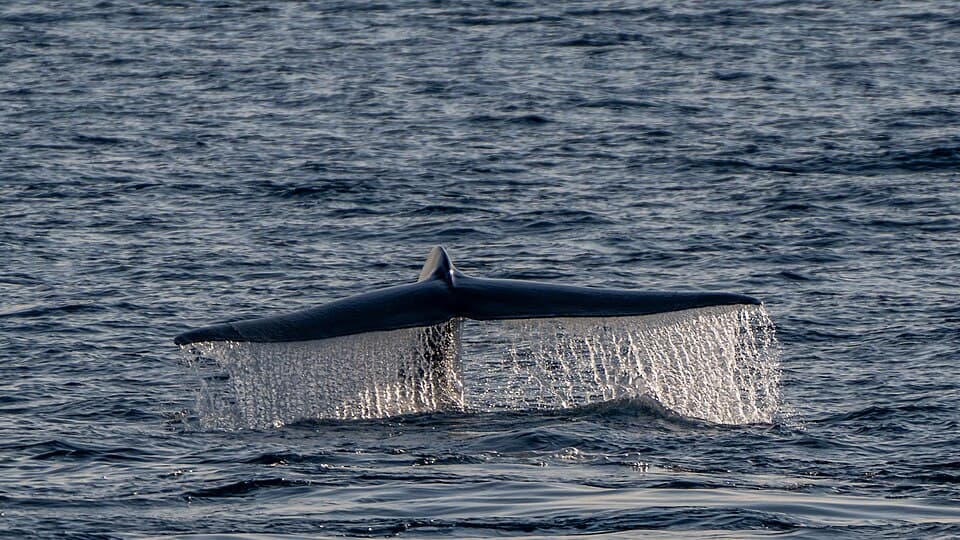
Photo: NOAA United States. National Marine Fisheries Service · Public domain · via Wikimedia Commons
Overview
The blue whale is the largest animal known to have ever existed — larger than any dinosaur — filtering enormous quantities of tiny krill from the ocean through comb-like baleen plates as it roams nearly every ocean on Earth except the high Arctic. Populations were driven to the edge of extinction by 20th-century commercial whaling before international protections took hold; an estimated 10,000 to 25,000 remain today, a small fraction of pre-whaling numbers.
Appearance
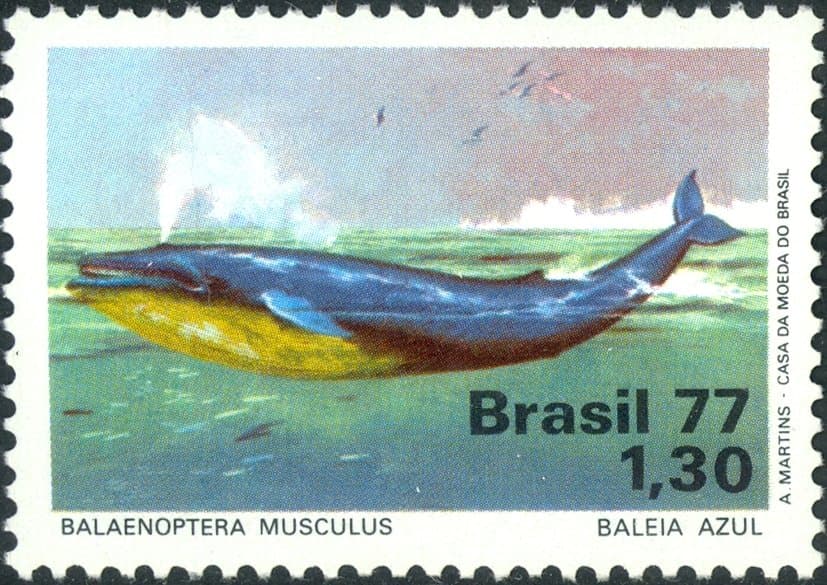
It has a long, streamlined, mottled blue-gray body, a broad flat head, and a small dorsal fin set far back near its tail. Along its throat and belly run dozens of expandable pleats — grooves that let its mouth balloon outward to engulf huge volumes of water in a single feeding lunge. Its heart alone can weigh as much as a small car, and its tongue can weigh as much as an adult elephant.
Habitat & Distribution
The blue whale is found in ocean habitats.
Diet & Behavior
Diet: Carnivore — Meat-eating animals that hunt, scavenge, or fish for prey, ranging from big cats to snakes and birds of prey.
Blue whales usually travel alone or in small groups, and feed using a technique called lunge feeding: they accelerate toward a dense patch of krill, open their mouth wide, and engulf a volume of water and prey that can exceed their own body weight, before forcing the water back out through their baleen plates and swallowing what remains. They undertake long seasonal migrations, spending summers feeding in cold, nutrient-rich polar and subpolar waters and moving to warmer tropical or subtropical waters to breed and give birth in winter. Their calls are among the loudest sounds produced by any animal, some too low in pitch for humans to hear, and can travel for hundreds of kilometers underwater — likely used to locate other whales across vast stretches of open ocean.
Predators
- Orca (occasionally, in packs)
Prey
- Krill
Interesting Facts
- 1
A blue whale's heart can weigh as much as a small car.
- 2
It can eat up to 4 tonnes of krill a day during feeding season.
- 3
Its calls can travel hundreds of kilometers underwater.
- 4
A newborn calf is already around 7 meters (23 feet) long and gains roughly 90 kg (200 lbs) a day nursing on its mother's milk.
- 5
Commercial whaling reduced global blue whale populations by an estimated 99% before international protections began in the 1960s.
- 6
Its throat has dozens of expandable pleats that let its mouth balloon outward while feeding.
Gallery
Blue Whale FAQs
How big is a blue whale's heart?
A blue whale's heart can weigh as much as a small car — around 180 kg (400 lbs) — and is the largest heart of any known animal.
Why are blue whales endangered?
Blue whales were hunted nearly to extinction by commercial whaling through the early-to-mid 20th century. International protections beginning in the 1960s stopped the decline, but populations remain a small fraction of pre-whaling numbers, which is why the species is still classified as endangered.
What do blue whales eat?
Blue whales eat almost exclusively krill, tiny shrimp-like crustaceans, which they filter from the ocean in enormous quantities using baleen plates instead of teeth.
How fast can a blue whale swim?
Blue whales typically cruise at a few kilometers per hour but can reach bursts of up to 50 km/h (31 mph) when they need to.
What does a blue whale eat?
The blue whale is a carnivore. Its diet includes krill.
Where does the blue whale live?
The blue whale is found in ocean habitats across north america and antarctica.
Is the blue whale endangered?
The blue whale has a conservation status of Endangered. Species facing a very high risk of extinction in the wild in the near future.
How long do blue whales live?
A blue whale's typical lifespan is 80–90 years in the wild.
How fast can a blue whale run?
The blue whale can reach speeds of up to 50 km/h.
How much does a blue whale weigh?
An adult blue whale typically weighs 100,000–150,000 kg.