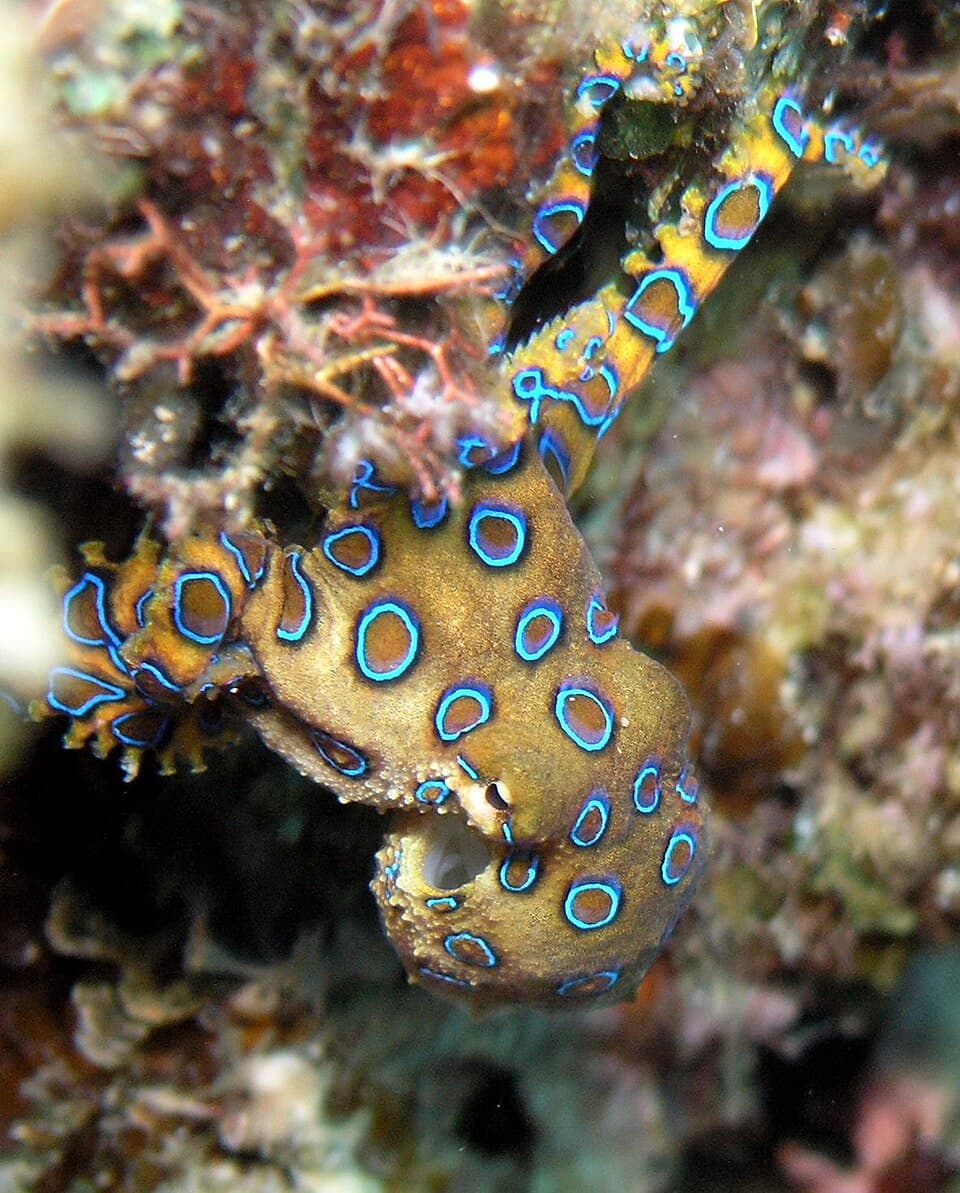
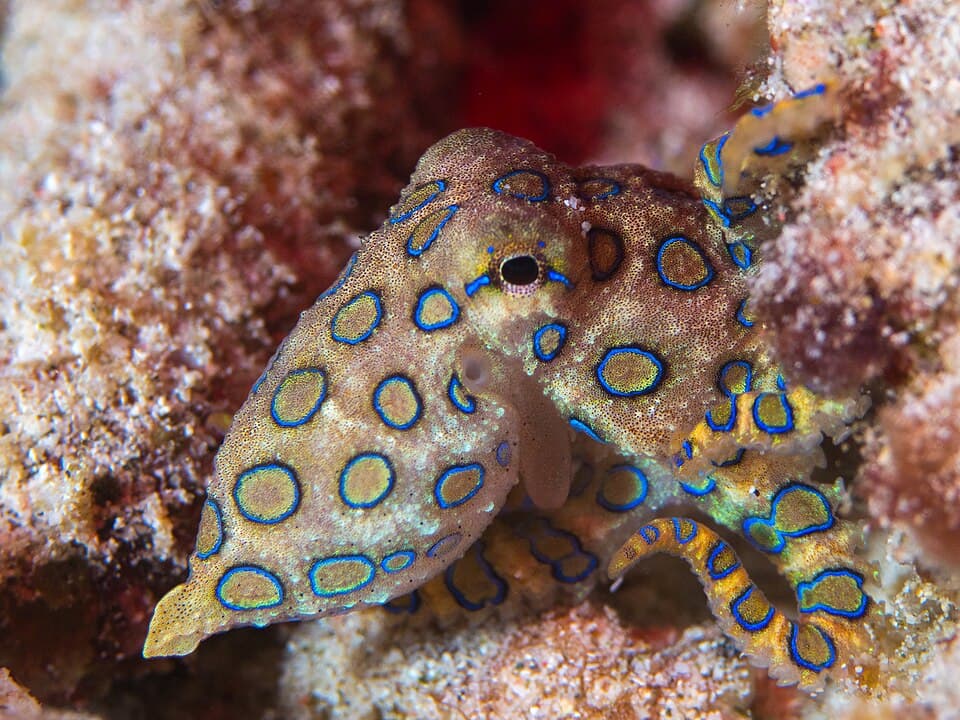
Photo: Jens Petersen · CC BY 2.5 · via Wikimedia Commons
Overview
The blue-ringed octopus is one of the most venomous marine animals in the world despite being barely larger than a golf ball, found in tide pools and shallow reefs across the Indo-Pacific. Its venom contains tetrodotoxin, a toxin powerful enough to cause paralysis in humans, though the octopus itself is docile and only bites when directly provoked or handled.
Appearance
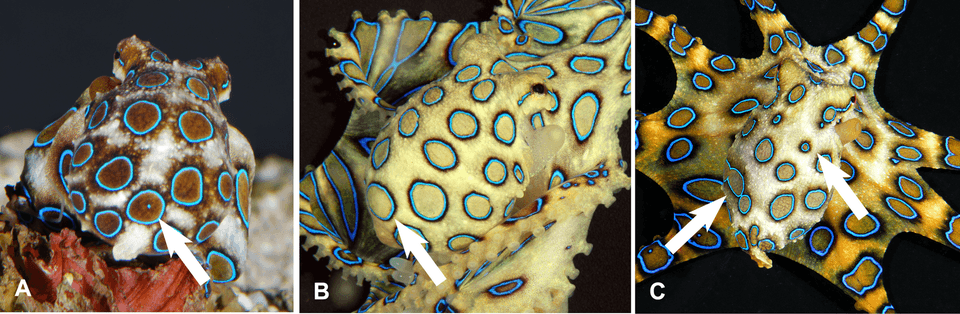
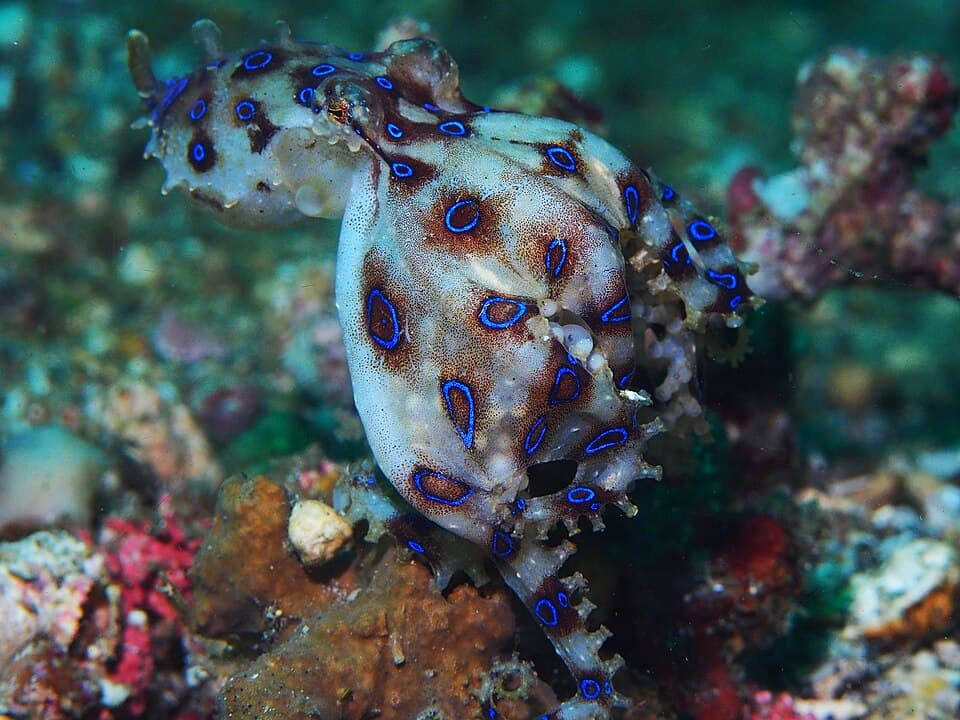
It has a small, soft body typically colored yellowish-brown, covered in iridescent blue rings and lines that flash vividly bright when the octopus feels threatened, serving as a clear warning signal to potential predators. Like all octopuses, it has eight flexible arms lined with suckers and no internal or external skeleton, letting it squeeze through remarkably small gaps.
Habitat & Distribution
The blue-ringed octopus is found in ocean habitats.
Diet & Behavior
Diet: Carnivore — Meat-eating animals that hunt, scavenge, or fish for prey, ranging from big cats to snakes and birds of prey.
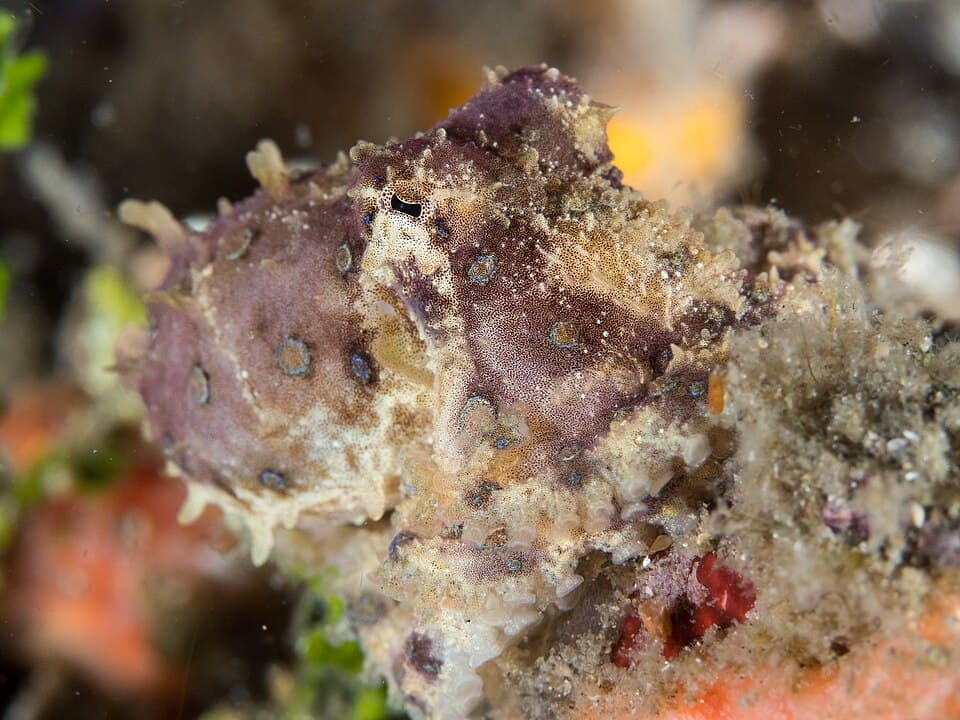
Blue-ringed octopuses spend much of their time hidden in crevices, shells, or debris on the seafloor, emerging to hunt small crabs and shrimp using their venomous bite to subdue prey quickly. When threatened, its normally dull coloring is replaced almost instantly by bright, pulsing blue rings, a warning display that appears within a fraction of a second and is one of the fastest color changes known in any animal.
Predators
- Larger fish
- Eels
- Humans (rarely, via handling)
Prey
- Crabs
- Shrimp
- Small fish
Interesting Facts
- 1
Despite being smaller than a golf ball, the blue-ringed octopus carries enough venom to be potentially lethal to an adult human.
- 2
Its warning rings flash bright blue almost instantly when threatened, one of the fastest color changes known in the animal kingdom.
- 3
There is no antivenom for its bite, and treatment relies entirely on supportive care like artificial respiration until the toxin wears off.
- 4
Its bite is often painless, meaning a person may not immediately realize they've been envenomated.
- 5
Like other octopuses, it has no bones at all, letting it squeeze its body through gaps barely wider than its own eye.
Gallery
Blue-Ringed Octopus FAQs
How dangerous is a blue-ringed octopus really?
Its venom contains tetrodotoxin, a neurotoxin potent enough to cause paralysis and, in severe untreated cases, death in humans. However, bites are rare and only occur when the octopus is directly handled or provoked, since it is normally shy and avoids confrontation.
Is there an antivenom for a blue-ringed octopus bite?
No -- there is no antivenom. Treatment relies on supportive medical care, particularly artificial respiration to keep a victim breathing until the paralytic effects of the toxin wear off, typically within a day.
Why does it flash blue rings?
The bright blue rings are a warning display, flashed almost instantly when the octopus feels threatened, signaling to potential predators that it is dangerous and should be left alone.
What does a blue-ringed octopus eat?
It hunts small crabs, shrimp, and occasionally small fish, using its venomous bite to quickly subdue prey.
What does a blue-ringed octopus eat?
The blue-ringed octopus is a carnivore. Its diet includes crabs, shrimp, small fish.
Where does the blue-ringed octopus live?
The blue-ringed octopus is found in ocean habitats across asia and australia.
Is the blue-ringed octopus endangered?
The blue-ringed octopus has a conservation status of Least Concern. Widespread and abundant species that are not currently at significant risk of extinction.
How long do blue-ringed octopuss live?
A blue-ringed octopus's typical lifespan is 1–2 years in the wild.
How much does a blue-ringed octopus weigh?
An adult blue-ringed octopus typically weighs 0.01–0.03 kg.