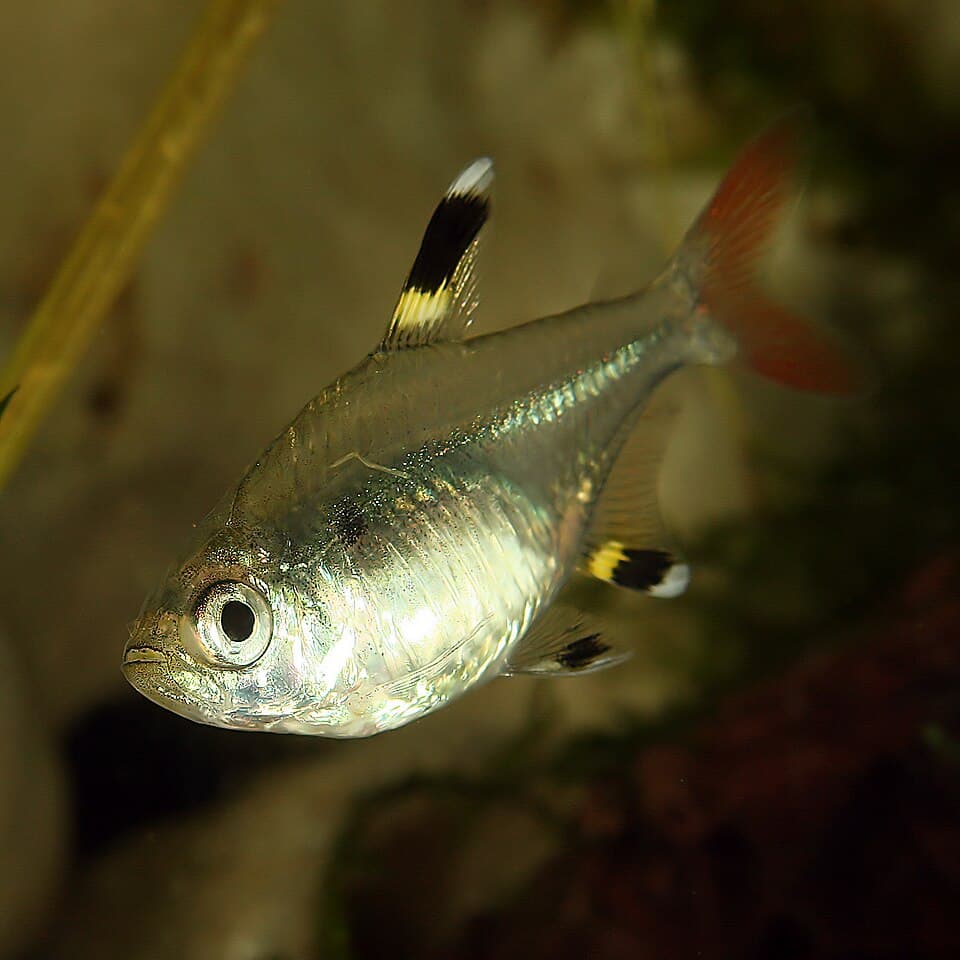
Photo: Richard Bartz, Munich Makro Freak · CC BY-SA 2.5 · via Wikimedia Commons
Overview
The X-ray tetra is a small freshwater fish native to slow-moving rivers and streams in South America, named for its almost completely transparent body that reveals its skeleton and internal organs. Its see-through appearance has made it one of the most recognizable and popular small fish in the freshwater aquarium hobby worldwide.
Appearance
It has a nearly transparent, silvery body through which its spine and internal organs are visible, along with a distinctive yellow, black, and white pattern on its dorsal and anal fins that provides one of the only solid blocks of color on an otherwise see-through fish.
Habitat & Distribution
The x-ray tetra is found in rainforest, wetlands habitats.
Diet & Behavior
Diet: Omnivore — Animals with flexible diets that eat both plants and animals, adapting to whatever food is available in their environment.
X-ray tetras are peaceful schooling fish that spend their time swimming together in loose groups through slow-moving water, feeding on small invertebrates, algae, and plant matter drifting in the current. Schooling behavior offers protection in numbers, since a tight group of nearly transparent fish is considerably harder for a predator to single out and target than one swimming alone.
Predators
- Larger fish
- Wading birds
Prey
- Small invertebrates
- Algae
- Plant matter
Interesting Facts
- 1
The X-ray tetra's body is nearly transparent, letting its skeleton and internal organs show through its skin.
- 2
It's one of the most popular small fish in the freshwater aquarium hobby, prized specifically for its see-through appearance.
- 3
Schooling together in groups makes it harder for predators to single out one nearly transparent fish from the rest.
- 4
Despite its delicate look, it's a hardy species able to tolerate a wide range of water conditions.
- 5
Its name comes directly from its resemblance to an X-ray image, since its bones are visible through its skin.
X-Ray Tetra FAQs
Why is the X-ray tetra transparent?
The X-ray tetra's skin and scales are naturally thin and lack heavy pigmentation, making its body nearly see-through and revealing its spine and internal organs, an adaptation that may help it blend into dappled light in its natural habitat.
Where do X-ray tetras live in the wild?
X-ray tetras are native to slow-moving rivers, streams, and floodplains in South America, particularly in the Amazon and Orinoco river systems.
Are X-ray tetras good for aquariums?
Yes -- X-ray tetras are a popular and hardy choice for freshwater aquariums, valued for their peaceful schooling behavior and unusual transparent appearance.
What do X-ray tetras eat?
In the wild, X-ray tetras are omnivores that eat small invertebrates, algae, and drifting plant matter.
What does a x-ray tetra eat?
The x-ray tetra is an omnivore. Animals with flexible diets that eat both plants and animals, adapting to whatever food is available in their environment.
Where does the x-ray tetra live?
The x-ray tetra is found in rainforest, wetlands habitats across south america.
Is the x-ray tetra endangered?
The x-ray tetra has a conservation status of Least Concern. Widespread and abundant species that are not currently at significant risk of extinction.
How long do x-ray tetras live?
A x-ray tetra's typical lifespan is 3–5 years in the wild.
How much does a x-ray tetra weigh?
An adult x-ray tetra typically weighs 0.001–0.003 kg.