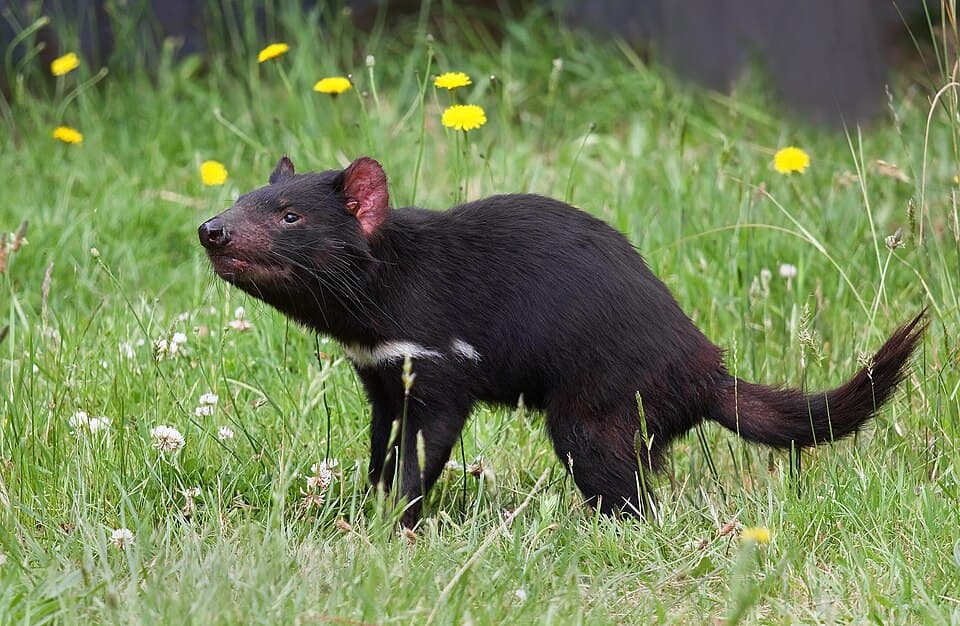
Photo: JJ Harrison (https://www.jjharrison.com.au/) · CC BY-SA 3.0 · via Wikimedia Commons
Overview
The Tasmanian devil is the largest surviving carnivorous marsupial in the world, now found only on the Australian island of Tasmania after going extinct on the mainland centuries ago. Despite its stocky, unassuming build, it has one of the strongest bites relative to body size of any living mammal, capable of crushing bone.
Appearance
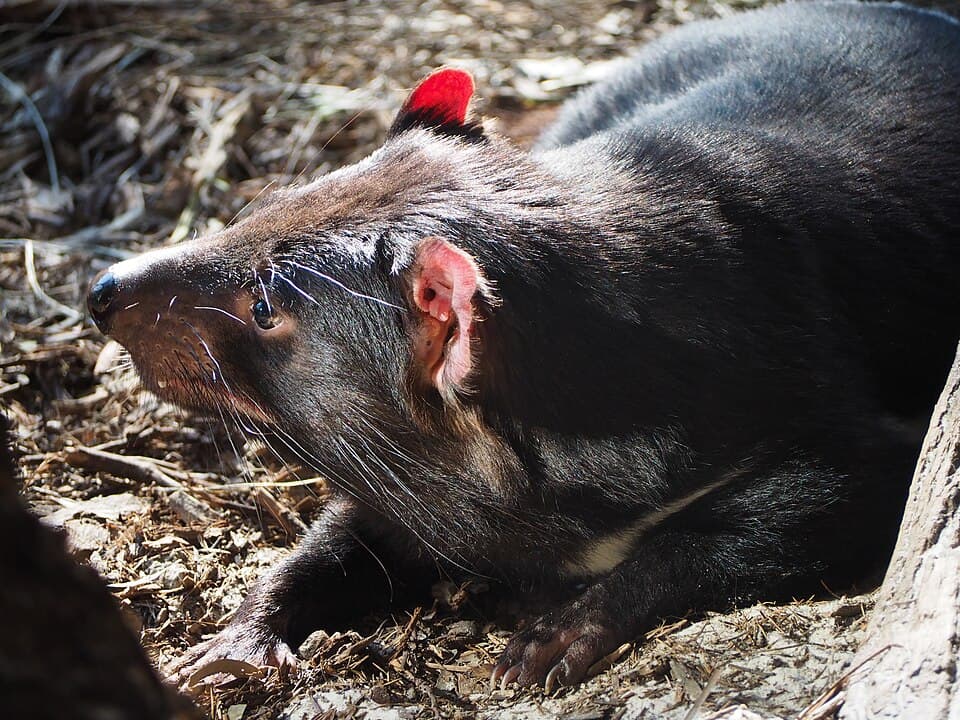
It has a stocky, muscular body covered in black fur, often with a white patch across the chest, a large head, and powerful jaws lined with sharp teeth adapted for crushing bone and tearing flesh. Its size is often surprising to people who only know it from cartoon depictions -- an adult is roughly the size of a small dog.
Habitat & Distribution
The tasmanian devil is found in forest, grassland habitats.
Diet & Behavior
Diet: Carnivore — Meat-eating animals that hunt, scavenge, or fish for prey, ranging from big cats to snakes and birds of prey.
Tasmanian devils are primarily scavengers, using an extremely powerful sense of smell to locate carrion, though they will also hunt live prey when the opportunity arises. They are famous for the loud, guttural screeches and growls they make when several individuals feed together at a carcass, a vocal display used to establish feeding order rather than genuine aggression in most cases.
Predators
- Humans
- Introduced dogs (historically)
Prey
- Carrion
- Small mammals
- Birds
- Reptiles
- Insects
Interesting Facts
- 1
The Tasmanian devil has one of the strongest bites relative to its body size of any living mammal.
- 2
Its loud screeches and growls, often heard when several devils feed together, are mostly a bluffing display rather than real aggression.
- 3
A contagious facial tumor disease has caused a severe, ongoing decline in wild Tasmanian devil populations since the 1990s.
- 4
It once lived across mainland Australia but has been restricted to the island of Tasmania for several hundred years.
- 5
Despite being a marsupial, it fills an ecological role similar to hyenas or jackals on other continents, as a dominant scavenger.
Gallery
Tasmanian Devil FAQs
Why are Tasmanian devils endangered?
A contagious facial tumor disease, first observed in the 1990s, has caused a severe decline in wild Tasmanian devil populations, spread through the biting behavior devils use when feeding and fighting.
Why do Tasmanian devils only live in Tasmania?
Tasmanian devils once ranged across mainland Australia but disappeared there several hundred years ago, likely due to competition with dingoes and other pressures, surviving only on the predator-free island of Tasmania.
How strong is a Tasmanian devil's bite?
Relative to its body size, the Tasmanian devil has one of the strongest bites of any living mammal, strong enough to crush bone -- an adaptation that lets it consume an entire carcass, including bones and fur.
Are Tasmanian devils actually aggressive?
Their loud screeching and growling can sound ferocious, but this behavior is mostly a bluffing display used to establish order when several devils feed at the same carcass, rather than genuine aggression toward each other.
What does a tasmanian devil eat?
The tasmanian devil is a carnivore. Its diet includes carrion, small mammals, birds, reptiles.
Where does the tasmanian devil live?
The tasmanian devil is found in forest, grassland habitats across australia.
Is the tasmanian devil endangered?
The tasmanian devil has a conservation status of Endangered. Species facing a very high risk of extinction in the wild in the near future.
How long do tasmanian devils live?
A tasmanian devil's typical lifespan is 5–8 years in the wild.
How much does a tasmanian devil weigh?
An adult tasmanian devil typically weighs 4–12 kg.